
How to Market a New Real Estate Project in India (2026)
The Complete Blueprint to Generate Qualified Leads, Build Trust, and Sell Faster
By Avani Studios | Updated for 2026
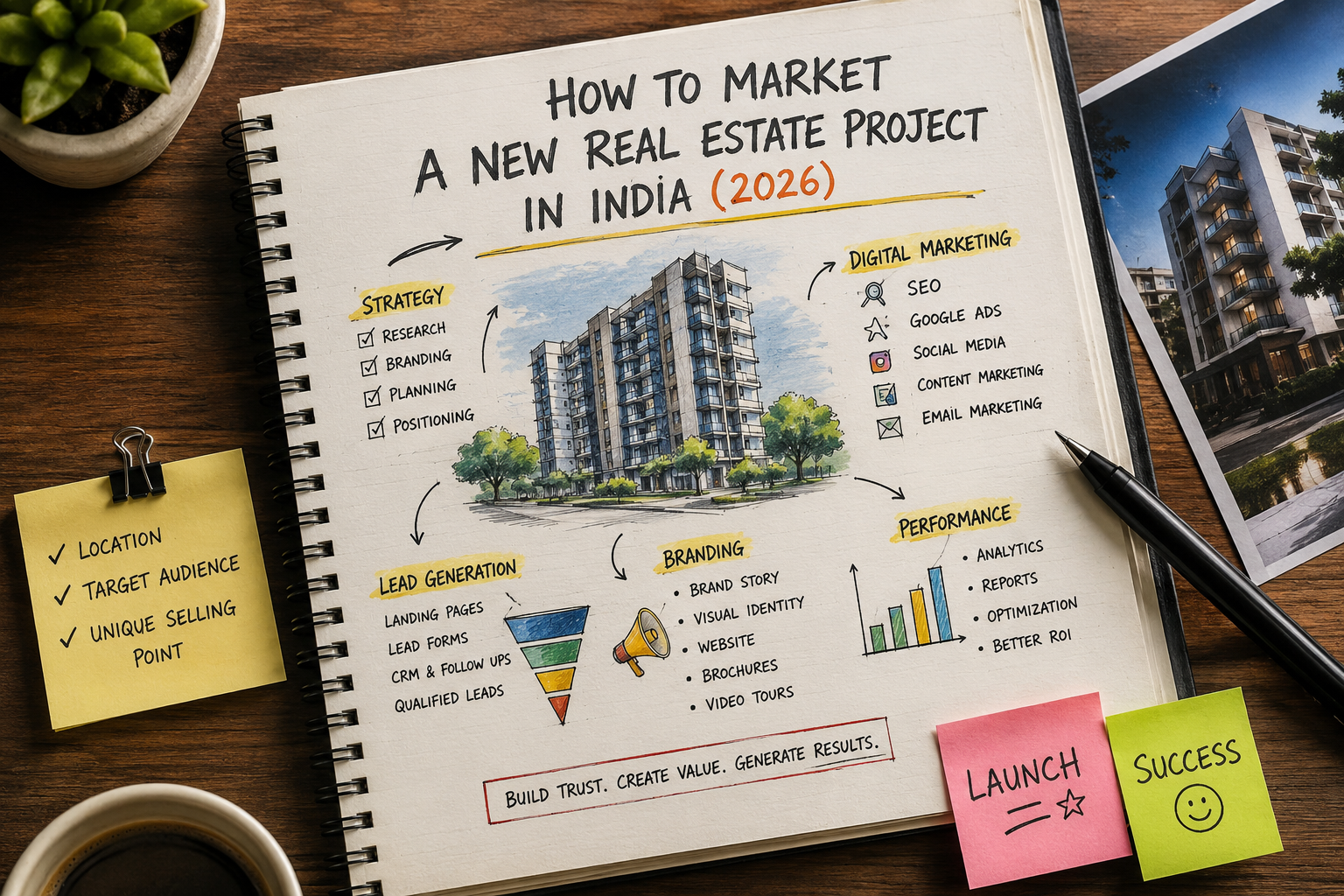
Quick Answer: Marketing a new real estate project in India starts long before launch day. The highest-performing builders begin building trust months in advance through SEO, Google Business Profile, educational content, paid advertising, local branding, and a website designed to convert visitors into qualified enquiries. By launch, buyers already know the project, trust the builder, and are ready to book a site visit.
Table of Contents
- Why Great Projects Still Fail
- How Today’s Home Buyers Actually Make Decisions
- The Marketing Foundation Every Builder Needs Before Spending on Ads
- Pre Launch Marketing Strategy
- Launch Strategy
- Post Launch Growth
- SEO for Real Estate Projects
- AI, AEO & GEO
- Common Marketing Mistakes
- Frequently Asked Questions
Chapter 1
Why Great Real Estate Projects Still Fail to Sell
Every year, developers across India invest hundreds of crores into acquiring land, designing projects, obtaining approvals, and constructing world class residential communities.
Yet many of these projects struggle to generate enquiries.
The surprising part is that construction quality often isn’t the problem.
The problem is visibility.
Imagine two residential projects launching within a few kilometres of each other.
Both offer similar apartment sizes.
Both are RERA approved. [Real Estate Regulatory Authority]
Both are competitively priced.
Both have attractive amenities.
Yet six months after launch, one project has a packed sales office every weekend while the other waits for enquiries that never seem to arrive.
What changed?
Marketing.
Not flashy advertising.
Not viral social media posts.
Not oversized hoardings.
The winning project simply became familiar to buyers before they were ready to purchase.
Modern Buyers Don’t Start at Your Sales Office
Ten years ago, buyers often visited multiple projects before doing detailed research.
Today the process is reversed.
People research first.
They visit later.
Before contacting your sales team, buyers may have already:
- searched Google several times
- watched YouTube walkthroughs
- compared projects on property portals
- checked Google Reviews
- discussed options with family
- joined local WhatsApp groups
- asked AI assistants for recommendations
- compared neighbourhoods
- verified RERA registration
- calculated loan eligibility
By the time they fill your enquiry form, they’ve often eliminated half their options.
Marketing doesn’t create this demand.
It simply ensures your project is still being considered.
Marketing Doesn’t Sell Homes.
It Builds Confidence.
Buying a property isn’t an impulse purchase.
People don’t decide to purchase a ₹1 crore apartment after seeing a single advertisement.
Instead, every interaction slowly builds confidence.
A Google search.
A useful blog.
A positive review.
A professional website.
Construction updates.
Helpful sales conversations.
Every small interaction reduces uncertainty.
Eventually uncertainty becomes trust.
Trust becomes a site visit.
The site visit becomes a booking.
Marketing exists to accelerate that journey.
Think About the Last Major Purchase You Made
Perhaps it was a phone.
A car.
Or even a laptop.
You probably didn’t buy the first option you saw.
You researched.
Compared.
Read reviews.
Watched videos.
Asked friends.
Eventually one brand felt more trustworthy than the others.
Buying property follows the same psychology—only with much higher emotional and financial stakes.
Builders often believe they’re competing on price.
In reality they’re competing on confidence.
Visibility Wins Before Quality Gets a Chance
Imagine opening the best restaurant in your city.
The food is exceptional.
The chefs are experienced.
The interiors are beautiful.
But there is no signboard.
No Google Business Profile.
No reviews.
No website.
No online presence.
Across the street sits an average restaurant that appears first on Google, has hundreds of reviews, active social media, and local food bloggers talking about it.
Which one stays busy?
The better-marketed one.
Real estate works exactly the same way.
Quality matters.
But buyers have to discover your project before they can appreciate its quality.
The Real Cost of Starting Marketing Too Late
One of the biggest mistakes developers make is waiting until construction is nearly complete before thinking about marketing.
Unfortunately, search engines don’t work overnight.
Neither does trust.
SEO takes time.
Brand awareness takes time.
Google needs time to understand your website.
Buyers need repeated exposure before remembering your project.
By delaying marketing, builders sacrifice one of their biggest competitive advantages—the ability to create demand before launch.
The projects that sell fastest rarely begin marketing on launch day.
They begin months earlier.
Key Takeaways
- Great projects fail because buyers never discover them.
- Modern buyers research extensively before making contact.
- Marketing builds trust rather than creating demand.
- Familiarity significantly influences buying decisions.
- Builders who market early usually launch with stronger demand.
Chapter 2
Understanding How Home Buyers Make Decisions in 2026
The modern home buyer behaves very differently from buyers just a decade ago.
Technology has changed almost every step of the buying journey.
Understanding that journey is the foundation of successful marketing.
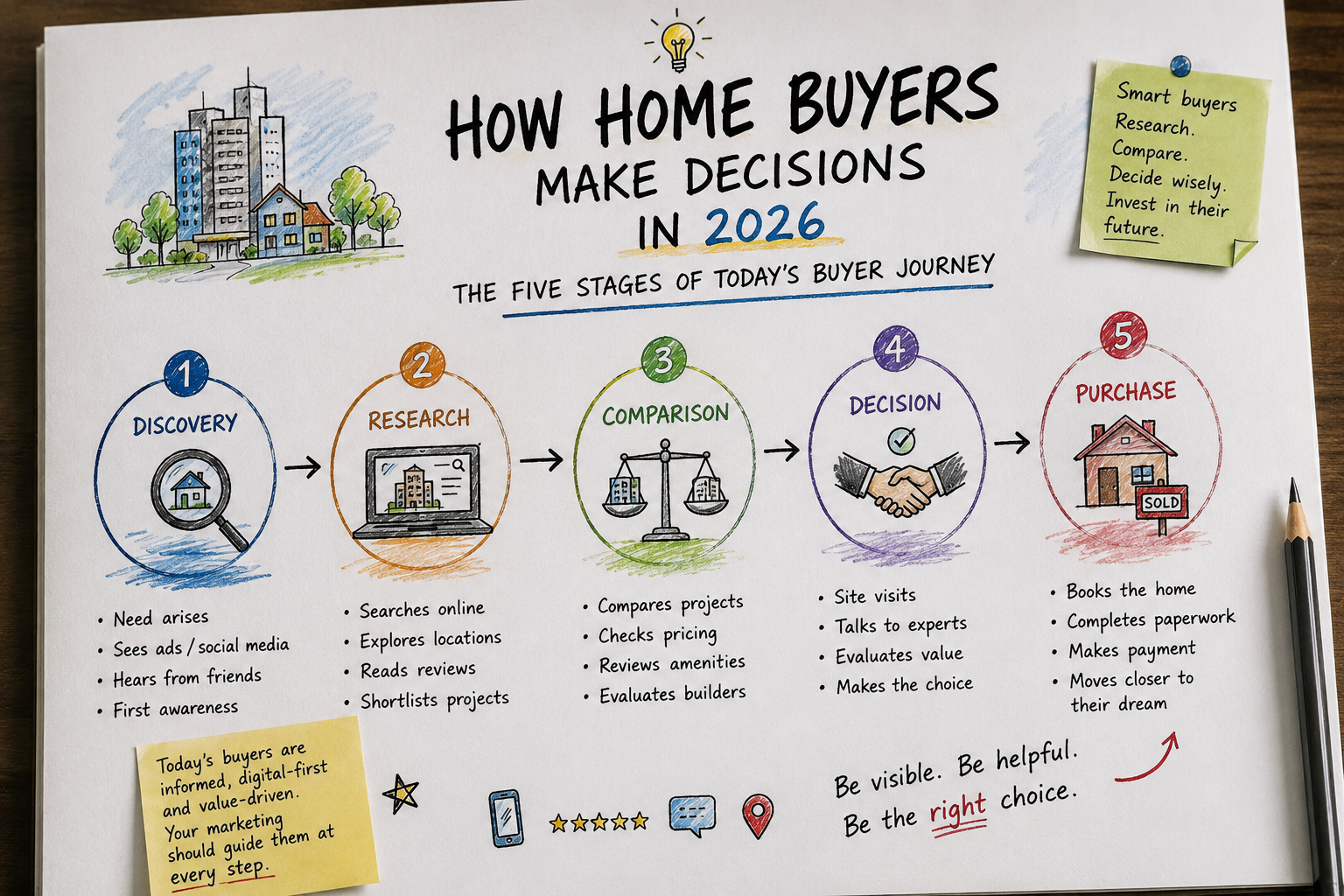
The Five Stages of Today’s Buyer Journey
Every buyer moves through five predictable stages.
1. Discovery
The buyer realises they need a home or investment property.
Typical searches include:
- apartments in Whitefield
- villas near Sarjapur
- best builders in Bengaluru
- new residential projects
At this stage they’re exploring possibilities.
Not choosing a builder.
2. Research
Now buyers begin asking deeper questions.
Can I trust this builder?
Is the project legally approved?
How good is the location?
What schools are nearby?
Is construction progressing?
This is where educational content becomes incredibly valuable.
Helpful blogs.
Location guides.
Construction updates.
Buying checklists.
Mortgage explanations.
Projects that answer these questions earn trust long before competitors do.
3. Comparison
The shortlist becomes smaller.
Now buyers compare:
- floor plans
- amenities
- builder reputation
- neighbourhood advantages
- payment plans
- connectivity
- reviews
Every unanswered question becomes an opportunity for another builder to win the customer.
4. Decision
Only now do buyers contact sales teams.
By this point your website, reviews, SEO, videos, and branding have already influenced most of the decision.
Sales representatives are often reinforcing trust—not creating it from scratch.
5. Purchase
Even after booking, marketing doesn’t stop.
Construction updates.
Customer communication.
Referral programmes.
Community engagement.
These activities create future advocates who become your most affordable source of qualified leads.
Every Marketing Channel Has a Different Job
One common mistake is expecting every platform to generate immediate sales.
That’s not how digital marketing works.
Google Search captures existing demand.
Meta Ads generate awareness.
SEO builds long-term visibility.
Email nurtures enquiries.
WhatsApp accelerates conversations.
Google Business Profile strengthens local trust.
Each channel supports a different stage of the buyer journey.
When used together, they create a consistent experience that moves prospects from curiosity to confidence.
Why Trust Has Become the Biggest Competitive Advantage
Buyers are surrounded by marketing.
Every builder claims to offer:
- luxury
- premium quality
- world-class amenities
- unmatched lifestyle
Eventually these words lose meaning.
Trust now comes from evidence.
Visible RERA information.
Professional photography.
Construction progress.
Real customer testimonials.
Fast communication.
Clear pricing.
Transparent answers.
The builders who consistently demonstrate credibility outperform those who simply make bigger promises.
Different Buyers Need Different Marketing
Treating every buyer the same reduces conversion rates.
NRI Buyers
Need virtual walkthroughs, WhatsApp communication, legal guidance, and confidence that decisions can be made remotely.
First Time Buyers
Need financing support, EMI calculators, buying education, and reassurance throughout the process.
Investors
Focus on rental demand, appreciation potential, infrastructure growth, and future ROI.
Luxury Buyers
Respond to exclusivity, lifestyle, design quality, privacy, and brand reputation.
One marketing message cannot persuade every audience equally well.
Key Takeaways
- Buyers complete most research before contacting sales teams.
- Every marketing channel serves a different purpose.
- Trust consistently outperforms exaggerated marketing claims.
- Segmenting audiences improves conversion rates.
- Marketing should support every stage of the buyer journey.
Chapter 3
Before You Spend ₹1 on Advertising, Build the Right Foundation

The first question many developers ask is:
“How much should we spend on Google Ads?”
The better question is:
“Is our business ready for the traffic those ads will generate?”
Running paid campaigns without a solid foundation is like pouring water into a leaking bucket.
Traffic alone doesn’t generate enquiries.
A well-prepared marketing system does.
Your Website Is Your Digital Sales Office
Many buyers will visit your website before speaking with anyone from your company.
In many cases, it creates their first impression.
A high-performing real estate website should immediately answer six questions:
- What is this project?
- Where is it located?
- Why is it different?
- Can I trust this builder?
- How do I book a visit?
- How do I contact someone right now?
If visitors cannot answer those questions within ten seconds, your website is losing potential enquiries.
Speed Matters More Than Beautiful Design
A visually impressive website that loads slowly often performs worse than a simpler site that loads instantly.
Every additional second increases the chance that visitors leave before exploring the project.
Fast websites also perform better in Google Search because page speed is an important ranking and user experience factor.
Optimising images, improving Core Web Vitals, reducing unnecessary scripts, and ensuring mobile responsiveness should be priorities before increasing advertising spend.
Your CRM Is More Valuable Than Another Advertising Campaign
Many developers lose leads not because marketing failed, but because follow-up failed.
A prospective buyer comparing three projects often books a site visit with the first sales team that responds professionally.
A CRM helps ensure every enquiry is assigned, tracked, and followed up consistently.
Combined with WhatsApp automation and call tracking, it prevents qualified prospects from slipping through the cracks.
Analytics Should Guide Every Decision
Without measurement, marketing becomes guesswork.
Before launching campaigns, ensure you have:
- Google Analytics 4 configured correctly
- Google Search Console connected
- Conversion tracking for forms and calls
- Meta Pixel installed
- Google Ads conversion tracking
- CRM attribution where possible
These tools allow you to understand not only how many visitors arrive, but which marketing activities actually generate qualified enquiries.
Your Brand Should Answer One Simple Question
Why should buyers choose your project instead of another nearby?
If your answer is simply “premium quality” or “luxury living,” you’re unlikely to stand out.
A stronger positioning statement focuses on genuine advantages such as location, design, sustainability, family-friendly planning, connectivity, or investment value.
Specificity is far more persuasive than generic marketing language.
Foundation Checklist
Before investing in advertising, make sure you have:
✓ A fast, mobile-friendly website
✓ Clear positioning and branding
✓ CRM integrated with all enquiry channels
✓ WhatsApp click-to-chat
✓ Google Analytics 4 and Search Console
✓ Conversion tracking
✓ Google Business Profile
✓ RERA information displayed clearly
✓ Professional project photography
✓ High-quality landing pages for campaigns
Key Takeaways
- Advertising cannot fix a weak marketing foundation.
- Your website should function as your best salesperson.
- Speed, usability, and trust influence conversions more than visual design alone.
- CRM and analytics are essential for measuring marketing ROI.
- Strong positioning gives buyers a reason to choose your project.
Chapter 4
The Pre Launch Blueprint :
How to Build Demand Before Your Project Officially Launches
Most builders think marketing begins when the project is ready to sell.
The highest-performing builders know it begins months earlier.
By the time bookings officially open, many successful projects already have hundreds of interested buyers following construction updates, visiting the website, downloading brochures, and waiting for pricing announcements.
That’s not luck.
It’s the result of a structured pre-launch marketing strategy.
Instead of launching into silence, you’re launching into an audience that already knows who you are.
Why Pre Launch Marketing Matters
Think about two developers launching similar apartment projects.
Builder A spends almost nothing on marketing until construction is well underway. Their first major campaign begins a week before launch.
Builder B starts six months earlier.
During those six months they:
- Publish educational blog articles.
- Improve their Google Business Profile.
- Share weekly construction updates.
- Run awareness campaigns.
- Build an email database.
- Capture WhatsApp enquiries.
- Create local SEO content.
- Produce walkthrough videos.
- Answer common buyer questions.
When launch day arrives, Builder B isn’t introducing a new project.
They’re inviting an audience that’s already familiar with it.
That difference often determines how quickly bookings begin.
The Three Goals of Pre Launch Marketing
Before discussing channels or budgets, define what success actually looks like.
Your pre launch strategy should achieve three objectives.
Goal 1 — Build Awareness
People can’t buy a project they’ve never heard about.
During pre launch, your objective isn’t to close sales.
It’s to ensure your target audience repeatedly sees your project, your brand, and your expertise.
Awareness creates familiarity.
Familiarity creates trust.
Trust increases enquiries.
Goal 2 — Build Credibility
Buyers aren’t just evaluating apartments.
They’re evaluating the builder.
Questions naturally arise:
- Can this developer deliver on time?
- Are approvals complete?
- Is the location genuinely good?
- Is construction progressing?
- Does the builder communicate transparently?
Every blog, construction update, video, review, and social media post helps answer those questions before they’re even asked.
Goal 3 — Capture Future Buyers
Not everyone is ready to purchase immediately.
Someone researching today might book three months later.
Without a lead capture system, those visitors disappear forever.
Every pre-launch campaign should encourage visitors to:
- Join a priority access list.
- Download a brochure.
- Request pricing updates.
- Schedule an early consultation.
- Join your WhatsApp updates.
The goal isn’t immediate sales.
It’s building a qualified audience before launch.
Build a Website Before You Build Advertising
Many builders spend heavily on advertising while sending visitors to incomplete websites.
That’s one of the fastest ways to waste marketing budgets.
Before running campaigns, your website should already include:
- Project overview
- Location advantages
- Floor plans
- Amenities
- Builder profile
- RERA details (when available)
- Contact information
- Google Maps integration
- Frequently Asked Questions
- Fast mobile performance
Remember:
Your website isn’t an online brochure.
It’s your digital sales office.
Every visitor should immediately understand:
- What you’re building.
- Why it’s different.
- Who it’s designed for.
- How to enquire.
Start SEO Before Anyone Searches for You
One of the biggest misconceptions in real estate marketing is that SEO should begin after launch.
In reality, that’s already late.
Google needs time to understand new websites.
It needs time to crawl pages.
Index content.
Build authority.
Earn backlinks.
Develop trust.
Waiting until launch delays organic growth by months.
Instead, begin publishing valuable content while construction is still underway.
Examples include:
- How to choose the right apartment in Bengaluru
- Apartment vs villa investment
- Understanding RERA approvals
- Home loan guide for first-time buyers
- Best schools near your project location
- Infrastructure developments nearby
- Local neighbourhood guides
Notice something?
Most of these articles aren’t advertisements.
They’re genuinely useful resources.
That’s exactly why they rank.
And once visitors trust your expertise, they’re naturally introduced to your project.
Local SEO Begins Before Launch
If your project serves buyers in a specific city or locality, local SEO should become a priority immediately.
Start by optimising:
- Google Business Profile
- Business categories
- Opening hours
- Contact details
- Project location
- High-quality photographs
- Regular updates
- Frequently Asked Questions
Even before bookings begin, Google starts understanding your local relevance.
Over time this helps your project appear for valuable searches like:
- apartments near Whitefield
- villas in Sarjapur
- builders in Electronic City
- new residential projects Bengaluru
Local visibility compounds over time.
Starting early creates a competitive advantage that’s difficult to replicate later.
Content Marketing Builds Trust Faster Than Advertising
Advertising tells people you’re good.
Content proves it.
Instead of repeatedly saying your project is “premium,” demonstrate expertise by answering questions buyers genuinely have.
Examples include:
- What documents should buyers verify before booking?
- How does RERA protect homebuyers?
- How much down payment is usually required?
- What affects apartment resale value?
- Which neighbourhoods are growing fastest?
Educational content positions your company as an advisor rather than another advertiser.
That distinction dramatically improves trust.
Video Content Should Start Early
Many developers wait until the clubhouse and sample apartment are complete before creating videos.
That’s a missed opportunity.
Pre launch videos can include:
- Site progress updates
- Drone footage
- Architect interviews
- Construction milestones
- Neighbourhood highlights
- Infrastructure developments
- Design philosophy
- Builder introductions
People connect with stories far more than static images.
Video accelerates familiarity.
Build an Email and WhatsApp List Before Launch
Imagine launching with 1,500 interested buyers already waiting for pricing announcements.
That’s the power of lead nurturing.
Instead of relying entirely on advertising after launch, begin collecting leads months earlier.
Offer useful resources such as:
- Project brochure
- Location guide
- Investment report
- Home buying checklist
- Construction updates
In exchange, visitors provide their contact details.
Once launch begins, your first enquiries come from an audience that already knows your project.
Create a 90 Days Pre Launch Content Calendar
Consistency beats intensity.
Instead of posting randomly, follow a structured schedule.
Month 1
Focus on awareness.
Publish:
- Builder introduction
- Project announcement
- Location benefits
- Infrastructure updates
- Market insights
Month 2
Focus on trust.
Publish:
- Construction progress
- Educational blogs
- Team introductions
- Buyer FAQs
- Behind-the-scenes content
Month 3
Focus on conversion.
Publish:
- Project walkthroughs
- Floor plans
- Amenities
- Booking process
- Pricing announcements
- Early access invitations
Each month should gradually move buyers closer to making an enquiry.
Common Pre Launch Mistakes
Many projects lose momentum before launch because they make avoidable mistakes.
The most common include:
- Waiting until launch to begin SEO.
- Building a website at the last minute.
- Ignoring Google Business Profile.
- Publishing only promotional content.
- Not collecting leads before launch.
- Posting inconsistently on social media.
- Delaying photography and videography.
- Having no CRM to manage enquiries.
Fixing these issues early costs far less than correcting them after launch.
Pre-Launch Checklist
Before spending your first advertising rupee, confirm that you have:
✅ Fast, mobile-friendly website
✅ SEO foundation completed
✅ Google Business Profile optimised
✅ Lead capture landing page
✅ WhatsApp integration
✅ CRM configured
✅ Google Analytics 4
✅ Google Search Console
✅ Meta Pixel
✅ Google Ads conversion tracking
✅ Content calendar prepared
✅ Professional photography and video
✅ Email automation
✅ Construction update strategy
If several boxes remain unchecked, improving these foundations will usually produce better results than increasing your advertising budget.
Key Takeaways
- Start marketing 3–6 months before launch, not weeks before.
- Awareness, credibility, and lead capture are the three objectives of pre-launch marketing.
- SEO and Local SEO require time to deliver results, making early implementation essential.
- Educational content consistently outperforms purely promotional content.
- Build an audience before launch so you’re not relying solely on paid advertising when bookings open.
Free Pre-Launch Strategy Review
If your project is launching within the next six months, this is the ideal time to review your digital marketing foundation. At Avani Studios, we help builders identify gaps in SEO, websites, CRM setup, Google Ads readiness, and lead generation before launch so your marketing budget works harder from day one.
Chapter 5
Launch Strategy : Turning Marketing Into Qualified Site Visits
After months of preparation, your launch day finally arrives.
The website is live.
The sales office is ready.
The brochures are printed.
The sample apartment looks exceptional.
Now comes the question every builder asks:
“How do we generate qualified leads without wasting our marketing budget?”
The answer isn’t spending more money.
It’s building a marketing system where every channel has a clear purpose, every enquiry is tracked, and every visitor is guided toward booking a site visit.
Successful launches don’t happen because one advertisement goes viral.
They happen because dozens of small marketing activities work together.
Your Goal Isn’t More Traffic
Many developers celebrate when their website receives thousands of visitors.
Traffic feels exciting.
Unfortunately, visitors don’t pay construction costs.
Qualified buyers do.
Instead of asking:
“How many people visited our website?”
Ask:
- How many qualified enquiries did we receive?
- How many site visits were booked?
- How many visits became bookings?
- Which marketing channel generated the highest-quality buyers?
Those numbers determine whether your campaign is successful.
Build a Conversion Funnel, Not Just Advertisements
Every buyer moves through a journey.
Your marketing should guide them naturally.
A high-performing launch funnel typically looks like this:
Google Search / Meta Ads / SEO
↓
Landing Page
↓
WhatsApp or Lead Form
↓
CRM
↓
Sales Call (within five minutes)
↓
Site Visit
↓
Booking
Every stage should reduce friction.
If one step breaks, the entire funnel becomes less effective.
For example, excellent Google Ads cannot compensate for a slow website or delayed follow-up.
Google Ads — Capturing Buyers With High Purchase Intent
Google Ads reaches people who are already searching.
These users have immediate intent.
Typical searches include:
- apartments for sale in Whitefield
- villas in Sarjapur
- luxury apartments Bengaluru
- new residential projects near Electronic City
Because these buyers are actively looking, Google Ads usually generates some of the highest-quality enquiries.
However, success depends on matching each keyword with the right landing page.
Someone searching for “3 BHK apartments in Whitefield” should land on a page specifically about those apartments—not your homepage.
The more relevant the experience, the higher the conversion rate.
Meta Ads — Building Demand Before Buyers Search
Unlike Google, Meta Ads interrupt rather than capture demand.
People scrolling Instagram or Facebook aren’t necessarily looking for property today.
Your objective is to introduce the project, create familiarity, and encourage future enquiries.
The most effective Meta campaigns often include:
- Lifestyle videos
- Drone footage
- Project teasers
- Construction updates
- Customer testimonials
- Neighbourhood highlights
- Limited-time launch announcements
Instead of selling immediately, these campaigns build recognition.
Later, when buyers begin researching seriously, they already know your brand.
Why Landing Pages Convert Better Than Homepages
One of the most expensive mistakes builders make is sending every advertisement to the homepage.
Imagine clicking an advertisement promising:
“Luxury 3 BHK Apartments Near Whitefield Metro.”
Instead of seeing those apartments, you’re taken to a homepage discussing your entire company.
Most visitors leave.
A dedicated landing page should answer exactly what the advertisement promised.
An effective landing page includes:
- Clear headline
- Project highlights
- Floor plans
- Location advantages
- Amenities
- High-quality images
- Trust signals (RERA, awards, reviews)
- Frequently Asked Questions
- Contact form
- Click-to-WhatsApp
- Strong call-to-action
Every unnecessary distraction reduces conversions.
Speed Wins More Enquiries Than Bigger Budgets
Imagine two buyers submitting enquiry forms at exactly the same time.
Builder A responds within three minutes.
Builder B responds the following morning.
Who is more likely to secure the site visit?
In most cases, Builder A.
Multiple industry studies consistently show that responding quickly increases the likelihood of connecting with prospective customers.
For real estate, where buyers usually enquire with several projects at once, speed becomes a competitive advantage.
A CRM combined with automated notifications ensures no enquiry is overlooked.
Every Lead Should Enter a CRM Immediately
Without a CRM, enquiries quickly become difficult to manage.
Calls are missed.
Emails are forgotten.
WhatsApp conversations disappear.
Sales representatives lose track of follow-ups.
A CRM centralises every interaction.
It allows your team to:
- Assign enquiries automatically.
- Schedule follow up reminders.
- Record call outcomes.
- Track site visits.
- Measure conversion rates.
- Identify high-performing campaigns.
Marketing generates opportunities.
A CRM converts those opportunities into revenue.
Remarketing, Your Second Chance to Win Buyers
Most visitors don’t enquire during their first visit.
That doesn’t mean they’re not interested.
Remarketing allows you to reconnect with people who have already visited your website or engaged with your advertisements.
You can remind them about:
- Construction updates
- New offers
- Booking deadlines
- Price revisions
- Virtual walkthroughs
- Limited inventory
Because these users already know your project, remarketing campaigns often produce significantly better conversion rates than cold advertising.
Measure the Metrics That Actually Matter
Marketing dashboards often overwhelm developers with numbers.
Clicks.
Reach.
Impressions.
Likes.
Followers.
These metrics are useful—but they don’t directly indicate business success.
Instead, focus on metrics that influence revenue.
Monitor:
- Qualified enquiries
- Cost per enquiry
- Cost per site visit
- Site visit-to-booking ratio
- Booking value
- Return on advertising spend
- Organic enquiries
- Lead response time
These KPIs provide a much clearer picture of campaign performance than vanity metrics.
Budget Allocation for a Balanced Launch
Every project is different, so there is no universal marketing budget.
However, one common mistake is allocating nearly everything to advertising while neglecting the assets that make advertising effective.
A balanced launch usually invests across multiple areas:
- Website optimisation
- SEO
- Google Ads
- Meta Ads
- Professional photography and videography
- Content creation
- CRM
- Analytics
- Email marketing
- Remarketing
Diversifying investment creates a stronger marketing ecosystem than relying on a single channel.
Common Launch Mistakes
Even experienced developers sometimes reduce campaign performance through avoidable mistakes.
Examples include:
- Launching before the website is fully ready.
- Sending advertisements to generic pages.
- Ignoring mobile optimisation.
- Following up too slowly.
- Tracking clicks instead of qualified leads.
- Running Google Ads without conversion tracking.
- Depending entirely on one advertising platform.
- Treating SEO as something to start after launch.
Avoiding these mistakes often delivers a better return than increasing your advertising budget.
Launch Checklist
Before increasing advertising spend, confirm that you have:
✅ High-converting landing pages
✅ Google Ads campaigns
✅ Meta Ads campaigns
✅ CRM integration
✅ Click-to-WhatsApp
✅ Automated lead notifications
✅ Conversion tracking
✅ GA4 reporting
✅ Search Console monitoring
✅ Remarketing audiences
✅ Sales scripts
✅ Follow-up workflow
✅ Weekly performance reviews
Marketing works best when every component supports the next.
Key Takeaways
- The objective of launch marketing is qualified site visits, not just website traffic.
- Google Ads captures buyers with existing demand, while Meta Ads creates future demand.
- Dedicated landing pages consistently outperform generic homepages.
- Fast lead response significantly improves conversion rates.
- CRM, analytics, and remarketing are essential parts of a successful launch strategy.
- Measure revenue-focused KPIs rather than vanity metrics to optimise marketing performance.
Need a Launch Marketing Plan?
Every project has different goals, budgets, and buyer profiles. At Avani Studios, we create customised launch strategies that combine SEO, Google Ads, Meta Ads, landing pages, CRM integration, and analytics to help builders generate qualified enquiries and maximise marketing ROI from day one.
Chapter 6
Post Launch Growth : How to Keep Generating Qualified Leads After the Initial Buzz Fades
Launch day is exciting.
Your campaigns are live.
The sales office is busy.
Site visits are increasing.
The marketing team is celebrating the first wave of enquiries.
Then, a few weeks later, something changes.
The initial excitement slows down.
Website traffic begins to stabilize.
Advertising costs start increasing.
Competitors launch new projects nearby.
This is the stage where many builders make a costly mistake.
They reduce marketing because they believe the hardest part is over.
In reality, the opposite is true.
Post-launch marketing is where consistent growth is built.
The developers who continue communicating with buyers, improving their online presence, and optimising their campaigns are usually the ones that maintain a steady flow of qualified enquiries for months—or even years.
Launch Isn’t the Finish Line
Many people think marketing follows this pattern:
Launch → Sell → Stop Marketing
Successful developers follow a different model:
Launch → Measure → Improve → Build Trust → Generate Referrals → Continue Growing
Marketing is not an event.
It’s an ongoing process.
Every month after launch provides new opportunities to strengthen buyer confidence and improve campaign performance.
Continue Publishing Valuable Content
A common mistake is allowing the website and social media channels to become inactive after launch.
When buyers visit a project website that hasn’t been updated for months, it creates uncertainty.
Questions naturally arise.
Is construction progressing?
Is the project still active?
Has demand slowed?
Regular updates reassure buyers that the project is moving forward.
Useful post-launch content includes:
- Monthly construction progress
- Drone videos
- Buyer testimonials
- New amenities under development
- Infrastructure updates near the project
- Home-buying tips
- Investment insights
- Local neighbourhood guides
Fresh content also helps your website maintain and improve its SEO performance over time.
Construction Updates Build More Trust Than Sales Promotions
Every builder talks about future amenities.
Few consistently show progress.
Buyers appreciate transparency.
Instead of only posting polished marketing creatives, publish genuine construction updates.
Include:
- Photos from the construction site
- Drone footage
- Milestone achievements
- Engineer or architect interviews
- Timeline updates
- Completion percentages
Showing real progress builds confidence far more effectively than repeatedly claiming your project is “premium.”
Keep Improving Your SEO
SEO is never a one-time task.
Google rewards websites that continue improving.
After launch, focus on expanding your content ecosystem.
Publish articles around topics your buyers are actively searching for.
Examples include:
- Property investment trends in your city
- Best schools near your project
- Infrastructure developments
- Home loan updates
- Apartment buying guides
- Rental yield analysis
- Interior design inspiration
- Moving and relocation tips
Each new article strengthens your topical authority and creates additional opportunities to attract organic traffic.
Remember, every informative article can introduce future buyers to your project without relying entirely on paid advertising.
Turn Happy Customers Into Your Best Marketing Channel
Satisfied buyers are one of the most valuable assets a developer has.
People naturally trust recommendations from friends, family members, and colleagues more than advertisements.
Create a structured referral programme that rewards customers for introducing qualified buyers.
The reward doesn’t always need to be financial.
Builders often offer:
- Maintenance fee credits
- Clubhouse memberships
- Interior upgrade vouchers
- Gift cards
- Exclusive community benefits
A well-managed referral programme can generate highly qualified leads at a significantly lower acquisition cost than paid advertising.
Google Reviews Influence More Buyers Than You Think
Many buyers search the builder’s name before making contact.
One of the first things they see is your Google Business Profile.
A profile with recent, authentic reviews creates confidence.
Encourage satisfied customers to leave honest feedback after positive interactions such as:
- Site visits
- Booking confirmation
- Possession
- Customer support experiences
Never purchase fake reviews.
Google increasingly identifies unnatural review patterns, and buyers quickly recognise inauthentic feedback.
Instead, make it easy for genuine customers to share their experience.
Respond professionally to every review both positive and negative.
How a company responds often matters as much as the review itself.
Email Marketing Keeps Buyers Engaged
Not every enquiry converts immediately.
Some buyers compare projects for weeks or months.
Email marketing allows you to stay connected without becoming intrusive.
Useful emails include:
- Construction updates
- Market insights
- Home-buying tips
- Project milestones
- Event invitations
- Limited-time offers
- New inventory announcements
The objective isn’t to sell in every email.
It’s to remain helpful and memorable until the buyer is ready to make a decision.
Remarketing Should Continue Beyond Launch
Many visitors leave your website without filling out a form.
That doesn’t mean they aren’t interested.
They may still be comparing projects.
Remarketing campaigns help bring these visitors back by showing relevant messages based on their previous interactions.
For example:
- Someone who viewed 3 BHK apartments can later see advertisements featuring those exact floor plans.
- Someone who downloaded the brochure can receive updates about new construction milestones.
- Someone who booked a site visit but didn’t proceed can be reminded about inventory availability or upcoming events.
These campaigns are typically more cost-effective than targeting completely new audiences because they focus on people already familiar with your brand.
Optimise Your Campaigns Every Month
The best-performing marketing campaigns are rarely perfect on day one.
Continuous optimisation makes the difference.
Review campaign performance regularly.
Questions to ask include:
- Which keywords generated qualified enquiries?
- Which landing pages converted best?
- Which advertisements had the highest click-through rate?
- Which audience segments produced bookings?
- Where are users leaving the website?
- Which locations generated the strongest ROI?
Small improvements made consistently often outperform major redesigns done once a year.
Marketing should evolve alongside buyer behaviour.
Measure Business Growth, Not Marketing Activity
Marketing reports often contain dozens of charts and numbers.
Many of them look impressive.
Only a few directly impact business growth.
Focus on metrics that influence revenue:
- Qualified enquiries
- Site visits booked
- Site visit to booking conversion rate
- Cost per qualified lead
- Cost per booking
- Organic traffic growth
- Local keyword rankings
- Referral generated enquiries
- Repeat website visitors
These metrics help determine whether your marketing investment is creating long-term value.
Common Post Launch Mistakes
Many developers unintentionally slow their own growth after launch.
Common mistakes include:
- Reducing marketing too early.
- Stopping SEO after initial rankings improve.
- Ignoring customer reviews.
- Publishing inconsistent content.
- Forgetting remarketing campaigns.
- Failing to analyze campaign performance.
- Treating existing customers as completed sales instead of future advocates.
Avoiding these mistakes helps maintain a healthy pipeline of qualified buyers throughout the project’s lifecycle.
Post Launch Success Checklist
To maintain momentum after launch, ensure you are consistently:
✅ Publishing construction updates
✅ Creating new SEO content
✅ Monitoring keyword rankings
✅ Collecting Google reviews
✅ Running remarketing campaigns
✅ Sending regular email updates
✅ Tracking campaign KPIs
✅ Improving landing pages
✅ Analysing CRM data
✅ Encouraging customer referrals
Marketing doesn’t stop after launch.
It evolves.
The builders who continue improving after launch often outperform competitors that rely solely on initial advertising campaigns.
Key Takeaways
- Launch day is the beginning of long-term marketing—not the end.
- Consistent communication keeps buyers engaged and builds trust.
- Fresh content and ongoing SEO improve long-term organic visibility.
- Customer referrals and Google reviews become powerful lead-generation assets.
- Regular optimisation based on real performance data produces better ROI than simply increasing advertising spend.
Grow Beyond Launch with Avani Studios
Successful projects don’t rely on launch campaigns alone. At Avani Studios, we help builders build sustainable lead-generation systems through ongoing SEO, Google Ads optimisation, content marketing, local SEO, CRM analytics, remarketing, and conversion-focused website improvements so enquiries continue long after the initial launch excitement has passed.
Chapter 7
Real Estate SEO : How to Rank Higher on Google and Generate Organic Leads for Years
Imagine two builders launching similar residential projects in the same locality.
Both invest in Google Ads.
Both run Meta campaigns.
Both have experienced sales teams.
One difference changes everything.
One builder appears on the first page of Google whenever buyers search for apartments in that location.
The other doesn’t.
Over time, the first builder receives a continuous stream of enquiries without paying for every click.
The second builder must keep increasing advertising budgets simply to maintain the same number of leads.
That’s the long-term value of Search Engine Optimization (SEO).
SEO isn’t about chasing algorithms.
It’s about becoming the most useful and trustworthy answer to the questions your future buyers are already asking.
Why SEO Matters More Than Ever in Real Estate
Most property journeys begin with a search.
Buyers search for:
- apartments in Whitefield
- villas in Sarjapur
- best builders in Bengaluru
- RERA-approved projects
- new launches near Electronic City
- luxury apartments in Pune
- investment properties in Hyderabad
These searches happen every day.
If your website isn’t visible when buyers are researching, you’re invisible during one of the most important stages of their decision-making process.
Unlike paid advertising, SEO continues generating visibility even when campaigns are paused.
That’s why many of the highest-performing builders treat SEO as a long-term business asset rather than a marketing expense.
Understand Search Intent Before Writing Content
One of the biggest SEO mistakes is trying to rank every page for every keyword.
Google rewards pages that match the searcher’s intent.
In real estate, search intent usually falls into four categories.
1. Informational Intent
The buyer wants to learn something.
Examples include:
- How to check RERA registration
- Apartment vs villa investment
- Home loan process in India
These pages build trust and attract early-stage buyers.
2. Commercial Investigation
The buyer is comparing options.
Typical searches include:
- Best builders in Bengaluru
- Google Ads vs Meta Ads for real estate
- Top residential projects near Whitefield
These users are closer to making a decision.
Your content should provide honest comparisons rather than promotional claims.
3. Transactional Intent
The buyer is ready to enquire.
Examples include:
- 3 BHK apartments for sale in Whitefield
- Villas near Sarjapur Road
- Luxury apartments Bengaluru
Landing pages should be built specifically for these keywords, with clear calls to action, pricing information where appropriate, trust signals, and enquiry forms.
4. Local Intent
Buyers often include locations in their searches.
Examples include:
- Builders near Electronic City
- Apartments in Whitefield
- Villas in Devanahalli
Optimising for local intent requires a combination of strong location pages, Google Business Profile optimisation, customer reviews, and locally relevant content.
Understanding search intent allows you to create pages that genuinely satisfy users instead of trying to force one page to rank for every possible keyword.
Build Topic Clusters Instead of Standalone Articles
Publishing one excellent blog is a good start.
Publishing a connected library of useful content is much more powerful.
Google increasingly rewards websites that demonstrate expertise across an entire subject rather than isolated pages.
Think of your website as a library.
Your pillar page introduces the complete topic.
Supporting articles explore each subject in greater depth.
For example:
Pillar Page
How to Market a New Real Estate Project in India
Supporting articles might include:
- Complete Pre-Launch Marketing Checklist
- Google Ads for Builders
- Meta Ads for Real Estate
- Local SEO for Builders
- RERA Explained
- Real Estate Website Design
- AI in Real Estate Marketing
- Home Buyer Marketing Trends
- Construction Update Best Practices
- Google Business Profile Guide
Each article should link naturally to related content.
This interconnected structure helps both users and search engines understand your expertise.
Local SEO Drives High Intent Buyers
When buyers search for projects near a specific location, Google relies heavily on local relevance.
Optimise your Google Business Profile by ensuring:
- Business information is accurate and consistent.
- Contact details are easy to verify.
- High quality project images are uploaded regularly.
- Construction updates are posted frequently.
- Customer reviews are encouraged.
- Questions are answered promptly.
Local SEO also benefits from creating location-specific content.
Examples include:
- Living in Whitefield
- Investment Potential of Sarjapur
- Best Schools Near Electronic City
- Metro Expansion and Property Prices
These articles answer real buyer questions while strengthening your relevance for local searches.
EEAT [Experience, Expertise, Authoritativeness, and Trustworthiness]:
Why Google Trusts Some Websites More Than Others
Google places particular importance on topics that can significantly affect people’s finances.
Real estate is one of those industries.
This is why Experience, Expertise, Authoritativeness, and Trustworthiness (EEAT) are essential.
Strengthen EEAT by:
- Publishing content written or reviewed by experienced professionals.
- Displaying clear company information.
- Showing RERA details where applicable.
- Including genuine project photography.
- Providing transparent contact information.
- Featuring authentic testimonials.
- Citing reliable sources when discussing market trends or regulations.
The more evidence Google sees that your business is legitimate and knowledgeable, the more confidence it has in recommending your content.
Technical SEO Creates the Foundation
Even exceptional content can struggle if technical issues prevent search engines from crawling or understanding your website.
Key technical priorities include:
- Fast page loading speeds.
- Mobile responsiveness.
- Secure HTTPS connection.
- XML sitemap.
- Robots.txt configuration.
- Clean URL structure.
- Optimised image sizes.
- Descriptive image alt text.
- Internal linking.
- Structured heading hierarchy.
Regular technical audits help identify problems before they impact rankings.
Structured Data Helps Search Engines Understand Your Content
Structured data (Schema Markup) gives Google additional context about your website.
Instead of guessing what a page represents, search engines receive clear information.
Useful schema types for real estate businesses include:
- Organization
- LocalBusiness
- Article
- FAQPage
- BreadcrumbList
- ImageObject
- VideoObject
- WebPage
Although structured data does not guarantee higher rankings, it improves the likelihood of enhanced search results and helps AI-powered search systems better understand your content.
Optimise Images for Search
Real estate websites rely heavily on visuals.
Large, unoptimised images often slow websites and reduce search performance.
Every image should include:
- Compressed file size.
- Descriptive filenames.
- Accurate alt text.
- Relevant captions where appropriate.
For example, instead of:
IMG_4582.jpg
Use:
luxury-3bhk-apartment-whitefield-bengaluru.jpg
Small improvements across dozens of images can significantly enhance website performance.
SEO Is an Ongoing Process
Many businesses expect SEO to deliver immediate results.
In reality, SEO compounds over time.
As your content library grows, your website earns backlinks, your technical performance improves, and your authority increases, rankings become more stable.
Unlike paid advertising, which stops generating traffic when budgets stop, SEO continues attracting qualified visitors long after the original content has been published.
That is why SEO should be viewed as an investment rather than an expense.
Common SEO Mistakes Builders Make
Many developers unintentionally limit their search visibility by making avoidable mistakes, such as:
- Publishing thin, generic content.
- Stuffing pages with keywords.
- Ignoring internal linking.
- Neglecting technical SEO.
- Creating duplicate location pages.
- Using stock images without optimisation.
- Failing to update old content.
- Overlooking Google Business Profile.
- Chasing rankings instead of solving buyer questions.
The websites that consistently answer real questions almost always outperform those focused solely on search engines.
Real Estate SEO Checklist
Before considering your SEO strategy complete, confirm that you have:
✅ Keyword research based on search intent
✅ Pillar pages with supporting topic clusters
✅ Optimised Google Business Profile
✅ Fast mobile-friendly website
✅ Structured data implemented
✅ Internal linking strategy
✅ High-quality educational content
✅ Technical SEO audit completed
✅ Optimised images
✅ Regular content updates
✅ Performance tracking through Google Analytics and Search Console
SEO is not a single campaign.
It is a long-term system that continuously increases your visibility, authority, and qualified lead generation.
Key Takeaways
- SEO helps builders generate sustainable organic enquiries without relying entirely on paid advertising.
- Understanding search intent leads to stronger rankings and better user satisfaction.
- Topic clusters establish topical authority and improve internal linking.
- Local SEO is essential for attracting buyers searching within specific cities and neighbourhoods.
- EEAT, technical SEO, structured data, and consistent content updates all contribute to long-term success.
Need Help Ranking Your Real Estate Website?
At Avani Studios, we build SEO strategies specifically for builders and developers. From technical audits and keyword research to content strategy, local SEO, and conversion-focused landing pages, our goal is simple: help your projects attract qualified buyers organically and reduce long-term dependence on paid advertising.
Chapter 8
AI, AEO & GEO : The Future of Real Estate Marketing Has Already Begun
A few years ago, buyers searched Google, clicked through websites, and compared projects manually.
Today, many buyers begin somewhere different.
Instead of typing multiple searches into Google, they ask AI assistants a complete question:
“I’m looking for a 3 BHK apartment in Bengaluru under ₹1.5 crore with good schools nearby, less than 10 minutes from a metro station, and built by a reliable developer. Which areas should I consider?”
Within seconds, AI provides a detailed answer.
Sometimes it even recommends locations, explains the pros and cons, and suggests what buyers should compare before making a decision.
This represents one of the biggest changes in digital marketing over the past decade.
Search is evolving from finding links to finding answers.
For builders and developers, that means your marketing strategy must evolve too.
AI Isn’t Replacing Marketing
It’s Changing How Buyers Discover Information
Whenever a new technology appears, people ask the same question:
“Will AI replace marketers?”
The better question is:
“Which parts of marketing will AI improve, and which still require human expertise?”
AI excels at processing information, identifying patterns, and assisting with repetitive tasks.
It can:
- Draft blog outlines.
- Generate content ideas.
- Analyse large datasets.
- Suggest keywords.
- Summarise research.
- Translate content.
- Personalise email campaigns.
- Automate routine customer support.
What AI cannot replace is the trust buyers place in experienced professionals.
No AI tool can visit your project, understand your brand values, build relationships with customers, or negotiate a property purchase.
Technology should strengthen your marketing—not replace the people behind it.
Understanding AEO
Answer Engine Optimization
Traditional SEO focuses on helping websites rank higher in search results.
AEO focuses on helping your content become the answer itself.
When someone asks:
“How do I market a new real estate project in India?”
Search engines and AI assistants look for content that provides a direct, well-structured answer.
Instead of burying important information halfway through a page, successful AEO content answers the question immediately.
For example:
Question
How long does SEO take for a real estate website?
Direct Answer
Most real estate websites begin seeing meaningful SEO improvements within three to six months, depending on competition, website quality, and content consistency.
After the direct answer, provide detailed explanations.
This format helps both readers and AI systems understand your content quickly.
Understanding GEO
Generative Engine Optimization
Generative AI doesn’t simply display a list of websites.
It generates responses by understanding information from multiple trusted sources.
Generative Engine Optimization (GEO) focuses on making your content easier for AI systems to understand, interpret, and reference accurately.
Content performs better when it includes:
- Clear headings.
- Logical structure.
- Accurate facts.
- Concise summaries.
- Consistent terminology.
- Well organised FAQs.
- Strong internal linking.
- Structured data (Schema).
In other words, the same practices that improve user experience also help AI understand your website.
Why Real Estate Is Perfect for AI Search
Property purchases involve hundreds of questions.
Buyers ask about:
- Pricing.
- Locations.
- Schools.
- Infrastructure.
- Legal approvals.
- Home loans.
- Rental income.
- Future appreciation.
- Builder reputation.
AI assistants are becoming increasingly useful for answering these early-stage questions.
Builders who publish genuinely helpful educational content increase their chances of being referenced when AI systems generate responses.
Write for People First
One of the biggest misconceptions about AI optimisation is that content should be written for machines.
The opposite is true.
AI systems consistently favour content that humans find useful.
Instead of writing:
“Luxury residential solutions delivering world-class lifestyle experiences.”
Write:
“Our project offers spacious 3 and 4 BHK homes with natural lighting, landscaped gardens, EV charging, and easy access to the metro.”
Specific information is easier for readers to understand—and easier for AI systems to interpret.
Clarity always wins.
AI Rewards Expertise
Generative AI increasingly prioritises trustworthy information.
That makes credibility more important than ever.
Strengthen your authority by including:
- Real case studies.
- Original insights.
- Construction updates.
- Expert commentary.
- Accurate data.
- Author information.
- Transparent company details.
- Genuine customer experiences.
Original experience is becoming one of the strongest competitive advantages in modern SEO.
Anyone can generate content.
Few businesses can demonstrate genuine expertise.
How AI Can Improve Your Marketing Workflow
AI is most valuable when it saves time without reducing quality.
Examples include:
Research
Summarizing regulations, market reports, and buyer trends.
Content Planning
Generating topic ideas based on search intent.
Draft Creation
Creating first drafts that experienced marketers refine and personalise.
SEO Support
Suggesting semantic keywords, headings, and internal linking opportunities.
Customer Support
Answering common enquiries outside business hours through intelligent chatbots.
Analytics
Identifying patterns across advertising campaigns, website traffic, and CRM data.
Used responsibly, AI allows marketing teams to focus more on strategy and creativity.
What Builders Should Avoid
As AI tools become more accessible, some businesses make the mistake of publishing unedited AI-generated content.
Buyers notice.
So does Google.
Common problems include:
- Generic writing.
- Repetitive wording.
- Inaccurate facts.
- Weak storytelling.
- Lack of local knowledge.
- No original insights.
- No brand personality.
AI should accelerate content creation.
It should never replace editorial judgement.
Every article should be reviewed, fact-checked, and improved by someone who understands both marketing and the real estate industry.
Preparing Your Website for AI Search
To improve your visibility in AI-powered search experiences:
✅ Answer questions directly.
✅ Use descriptive headings.
✅ Include FAQ sections.
✅ Implement structured data.
✅ Build topic clusters.
✅ Publish original research.
✅ Demonstrate real-world expertise.
✅ Keep information updated.
✅ Improve page speed.
✅ Strengthen internal linking.
These practices benefit both traditional search engines and modern AI systems.
The Future Belongs to Helpful Brands
Technology will continue evolving.
Algorithms will change.
New AI tools will emerge.
Buyer expectations will increase.
One principle, however, remains constant.
Businesses that consistently help people make better decisions earn trust.
And trusted brands continue attracting customers regardless of how search technology evolves.
The objective isn’t simply to rank on Google.
It’s to become the most reliable source of information in your industry.
When that happens, search engines, AI assistants, and buyers all begin recommending your business naturally.
Key Takeaways
- AI is transforming how buyers discover information not replacing human expertise.
- Answer Engine Optimization (AEO) helps your content become the direct answer to buyer questions.
- Generative Engine Optimization (GEO) makes your website easier for AI systems to understand and reference.
- Clear, accurate, experience-driven content consistently outperforms generic AI-generated copy.
- Builders who combine expert knowledge with AI-assisted workflows will be better positioned for the future of digital marketing.
Future Proof Your Digital Marketing with Avani Studios
Search is evolving rapidly, but the fundamentals remain the same: helpful content, technical excellence, and genuine expertise. At Avani Studios, we combine proven SEO strategies with AI ready content, structured data, conversion optimisation, and advanced digital marketing systems to help builders stay visible today and prepared for the future of search.
Chapter 9
The 20 Marketing Mistakes That Quietly Cost Builders Crores
Most unsuccessful real estate marketing campaigns don’t fail because of one major decision.
They fail because of dozens of small mistakes that gradually reduce visibility, lower conversion rates, waste advertising budgets, and erode buyer trust.
The unfortunate reality is that many of these mistakes go unnoticed for months.
By the time developers realise something is wrong, they’ve already lost qualified buyers to competitors.
The good news?
Almost every one of these mistakes can be prevented with the right strategy.
Let’s look at the most common ones.
1. Starting Marketing Too Late
Perhaps the biggest mistake of all.
Many developers begin marketing only after construction is well underway.
By then, competitors may already have:
- Better Google rankings
- Stronger brand awareness
- Larger email lists
- More Google reviews
- Higher local visibility
Marketing should begin 3–6 months before launch, not a few weeks before bookings open.
2. Treating the Website Like an Online Brochure
A beautiful website doesn’t automatically generate enquiries.
Many builder websites showcase attractive images but fail to answer basic buyer questions.
Visitors should immediately understand:
- What the project offers
- Why it’s different
- Where it’s located
- How to enquire
- Why they should trust the builder
Every page should guide visitors towards a clear next step.
3. Believing More Traffic Equals More Sales
Ten thousand visitors mean very little if none become qualified buyers.
Successful marketing focuses on attracting the right audience, not the largest audience.
Quality consistently outperforms quantity.
4. Depending Entirely on Paid Advertising
Google Ads and Meta Ads can generate excellent leads.
But the moment you stop paying, traffic usually stops too.
SEO, content marketing, local SEO, email marketing, and referrals continue generating value long after the initial investment.
A balanced strategy always performs better than relying on a single channel.
5. Ignoring Search Engine Optimization
Some builders postpone SEO because paid advertising produces faster results.
Unfortunately, delaying SEO simply delays future organic growth.
By the time competitors have built authority, catching up becomes significantly harder.
SEO works best when started early and maintained consistently.
6. Following Up Too Slowly
Imagine a buyer enquiring with five different developers.
The first sales consultant who responds professionally often secures the first site visit.
A delayed response creates unnecessary opportunities for competitors.
Fast follow-up isn’t just good customer service.
It’s a competitive advantage.
7. Publishing Generic Marketing Content
Every builder claims to offer:
- Luxury living
- Premium amenities
- World-class design
- Unmatched quality
Buyers hear these phrases everywhere.
Instead, explain what actually makes the project valuable.
Specific details build confidence.
Generic promises rarely do.
8. Ignoring Mobile Users
Today, the majority of property research begins on smartphones.
If your website loads slowly, displays poorly, or makes enquiry forms difficult to complete, you’re losing potential buyers before conversations even begin.
Mobile-first design is no longer optional.
9. Forgetting Google Business Profile
Many developers invest heavily in advertising while neglecting one of Google’s most valuable free marketing platforms.
An optimised Google Business Profile improves:
- Local visibility
- Buyer trust
- Google Maps presence
- Customer engagement
It should be updated regularly with new photographs, construction progress, announcements, and reviews.
10. Measuring Vanity Metrics
Marketing reports often highlight:
- Likes
- Followers
- Reach
- Impressions
While useful, these numbers don’t necessarily indicate business growth.
Instead, monitor:
- Qualified enquiries
- Cost per lead
- Site visits
- Booking conversions
- Return on marketing investment
Business outcomes matter more than social media popularity.
11. Neglecting Existing Customers
Many builders focus entirely on acquiring new buyers.
Existing customers often become your strongest advocates.
Satisfied homeowners generate referrals, positive reviews, testimonials, and community trust.
Continuing to engage with customers after booking strengthens your brand and reduces future acquisition costs.
12. Using AI Without Human Review
Artificial Intelligence is a valuable productivity tool.
It should never replace professional judgement.
Publishing generic, repetitive, or inaccurate AI-generated content weakens credibility and reduces trust.
Every article should include original insights, local knowledge, and human editing.
13. Creating One Generic Landing Page
Different audiences have different needs.
An investor, a first-time buyer, and an NRI buyer are rarely persuaded by the same message.
Dedicated landing pages consistently outperform generic pages because they address specific concerns.
14. Ignoring Website Speed
Even a delay of a few seconds can increase bounce rates and reduce enquiries.
Fast-loading websites improve:
- User experience
- Search rankings
- Conversion rates
Performance optimisation should be treated as a business priority—not a technical afterthought.
15. Failing to Build Trust
Buying a property is one of the largest financial decisions most people ever make.
Trust is built through:
- Transparent communication
- Authentic photography
- Real testimonials
- Visible RERA information
- Clear contact details
- Regular updates
Every interaction should reduce uncertainty.
16. Inconsistent Branding
When your website, advertisements, brochures, and social media all communicate different messages, buyers become confused.
Consistency builds familiarity.
Familiarity builds trust.
Every customer touchpoint should reinforce the same brand identity.
17. Forgetting Internal Linking
Many businesses publish excellent articles but never connect them.
Internal links help readers discover related content while also helping search engines understand your website structure.
Strong internal linking improves both SEO and user experience.
18. Never Reviewing Performance
Marketing should never operate on assumptions.
Every month, ask:
- Which campaigns generated qualified enquiries?
- Which keywords converted?
- Which landing pages performed best?
- Where did visitors leave the website?
Continuous improvement is one of the biggest competitive advantages available.
19. Trying to Market to Everyone
Not every buyer wants the same thing.
Marketing becomes much more effective when campaigns target clearly defined audiences.
Whether you’re speaking to investors, families, NRIs, or luxury buyers, tailored messaging consistently produces stronger results.
20. Viewing Marketing as a Cost Instead of an Investment
Perhaps the most expensive mistake of all.
Marketing isn’t simply an expense on a balance sheet.
Done correctly, it’s the system that generates enquiries, strengthens your brand, improves trust, and supports long-term sales growth.
Builders who understand this often outperform competitors with much larger advertising budgets.
A Simple Self Assessment
Ask yourself these questions:
- Would buyers easily find our project through Google today?
- Does our website answer the questions buyers actually ask?
- Are we generating leads from multiple channels?
- Are we measuring conversions instead of clicks?
- Do we consistently publish useful content?
- Are enquiries followed up within minutes?
- Are we building long-term organic visibility?
If several answers are “no,” you’ve identified opportunities to improve your marketing before increasing your budget.
Key Takeaways
- Most marketing failures result from a series of small, preventable mistakes rather than one major decision.
- Building trust, responding quickly, and creating genuinely useful content have a greater long-term impact than simply increasing advertising spend.
- Diversifying your marketing across SEO, paid advertising, content, local SEO, and CRM creates a more resilient lead-generation system.
- Consistent measurement and optimisation allow campaigns to improve month after month.
- The developers who succeed are not always those with the biggest budgets they are often the ones with the clearest strategy and the strongest execution.
Avoid Costly Marketing Mistakes with Avani Studios
Every real estate project is different, but the principles of successful marketing remain the same. At Avani Studios, we help builders identify hidden weaknesses, optimise digital marketing systems, improve conversion rates, and build sustainable lead-generation strategies that continue delivering results long after launch.
Chapter 10
Frequently Asked Questions About Real Estate Marketing in India
By now, we’ve covered the complete marketing journey—from pre-launch planning to SEO, AI-powered search, and long-term lead generation.
The questions below are the ones builders, developers, and marketing teams ask us most often. If you’re planning to launch a residential or commercial project, these answers will help you make smarter marketing decisions.
What is real estate marketing?
Real estate marketing is the process of attracting, educating, and converting potential buyers through a combination of branding, websites, SEO, paid advertising, content marketing, local SEO, CRM systems, and sales follow-up.
The goal isn’t simply to generate traffic—it’s to generate qualified enquiries that become site visits and, ultimately, bookings.
When should marketing begin for a new real estate project?
Ideally, three to six months before launch.
This gives you enough time to:
- Build brand awareness.
- Improve Google rankings.
- Publish educational content.
- Capture early leads.
- Optimise your website.
- Create marketing assets.
Projects that start marketing early often experience stronger launch performance because buyers are already familiar with the brand.
How important is SEO for builders?
SEO is one of the highest-return marketing investments available.
Unlike paid advertising, SEO continues generating qualified traffic long after the initial work has been completed.
For builders, SEO helps attract buyers searching for:
- apartments in a specific location
- new launches
- investment opportunities
- builder comparisons
- home-buying advice
Strong SEO reduces long-term dependence on paid advertising while improving brand credibility.
Should builders choose Google Ads or Meta Ads?
The best strategy is usually to use both because they solve different problems.
Google Ads captures buyers who are actively searching for a property.
Meta Ads builds awareness among people who may not have started searching yet.
Used together, these platforms support the entire buyer journey rather than only one stage of it.
How much should a builder spend on digital marketing?
There is no universal budget.
The right investment depends on factors such as:
- Project size
- Sales targets
- Competition
- Target audience
- Launch timeline
- Geographic location
Instead of asking, “How much should we spend?”, ask:
“How many qualified enquiries do we need each month to achieve our sales goals?”
That question leads to much better budgeting decisions.
How long does SEO take to show results?
SEO is a long-term strategy.
Many websites begin seeing measurable improvements within three to six months, while highly competitive markets may take longer.
The advantage is that successful SEO compounds over time, creating sustainable organic visibility.
Does social media generate property sales?
Social media plays an important role, but rarely works in isolation.
Its primary strengths include:
- Building brand awareness.
- Showcasing construction progress.
- Sharing customer stories.
- Promoting events.
- Driving visitors to landing pages.
Most buyers still conduct additional research before making an enquiry.
Social media should support your broader marketing strategy—not replace it.
What makes a real estate website convert visitors?
A high converting website usually includes:
- Fast loading speed.
- Mobile friendly design.
- Clear project information.
- High quality visuals.
- Strong trust signals.
- Simple enquiry forms.
- WhatsApp integration.
- Clear calls to action.
The easier you make it for buyers to find information and contact your team, the higher your conversion rate is likely to be.
How can builders improve local visibility?
Local SEO is essential.
Focus on:
- Optimising your Google Business Profile.
- Collecting genuine customer reviews.
- Publishing location-based content.
- Keeping contact information consistent.
- Adding accurate maps and directions.
- Updating your profile regularly with new images and posts.
These activities help your business appear more prominently in local searches and on Google Maps.
Is AI replacing digital marketing agencies?
No. If you want complete Information regarding this then Click Here
AI is changing how agencies work, but it is not replacing strategic thinking, creativity, or relationship building.
The most successful agencies use AI to improve efficiency while relying on experienced professionals to develop strategy, create original content, analyse performance, and optimise campaigns.
Businesses should view AI as a powerful assistant not a replacement for expertise.
What metrics should builders track?
The most valuable KPIs include:
- Qualified enquiries
- Cost per qualified lead
- Site visits
- Site visit-to-booking ratio
- Booking value
- Return on advertising spend
- Organic traffic growth
- Local keyword rankings
- Referral generated leads
These metrics provide a much clearer picture of marketing performance than vanity metrics such as likes or impressions.
Final Thoughts
Real estate marketing has changed dramatically.
Today’s buyers complete most of their research before they ever contact a sales team.
They compare builders online.
Read reviews.
Watch videos.
Ask AI assistants.
Visit Google Maps.
Explore neighbourhoods.
And only then do they decide which projects deserve their attention.
This shift means builders can no longer rely solely on brochures, hoardings, or paid advertisements.
Successful projects combine:
- Strong branding
- Helpful content
- Search engine optimisation
- Local SEO
- Paid advertising
- High converting websites
- CRM driven follow-up
- Continuous performance improvement
No single tactic guarantees success.
Consistent execution across all these areas does.
The projects that sell faster are rarely those with the biggest marketing budgets.
More often, they’re the ones with the clearest strategy, the strongest digital foundation, and the discipline to keep improving over time.
Ready to Market Your Next Project? Click here
Whether you’re preparing for a pre launch campaign, planning a major residential development, or looking to improve the performance of an existing project, the right strategy can make a measurable difference.
At Avani Studios, we help builders and developers across India create digital marketing systems that don’t just generate traffic they generate qualified enquiries, site visits, and long-term growth.
Our services include:
- Search Engine Optimization (SEO)
- Google Ads Management
- Meta Ads Management
- High-Converting Real Estate Websites
- Local SEO & Google Business Profile Optimisation
- Landing Page Design
- Content Marketing
- AI-Ready Content Strategy (AEO & GEO)
- CRM Integration
- Marketing Analytics & Conversion Optimisation
Book a Free Strategy Session
If you’d like an honest review of your current marketing not a sales pitch we’re happy to help.
During a free consultation, we’ll review your website, visibility, lead generation process, and digital marketing strategy, then identify practical opportunities to improve performance.
Contact Avani Studios
📞 +91 98451 70384
📍 12th Cross Road, Remco BHEL Layout, Ideal Homes Township, Rajarajeshwari Nagar, Bengaluru – 560098
One Final Thought
Marketing doesn’t sell homes.
Trust does.
Marketing simply helps the right people discover that trust before they discover your competitors.
Build trust first.
Everything else becomes easier.